
Denmark’s only Catholic bishop says he sees a cautious but real shift in how Catholics in the country live and speak about their faith — even as the Church remains a tiny minority in one of Europe’s most secular societies.
Bishop Czesław Kozon, who has led the Diocese of Copenhagen since 1995, gave a wide-ranging interview to the magazine Katolskt magasin, reflecting on the state of the Church in Denmark, the challenges facing its faithful, and the signs of hope he has witnessed over three decades of pastoral service.
“Many politicians claim that Denmark is a Christian country,” said Bishop Kozon, “but in people’s daily lives one can hardly find any traces of Christianity.”
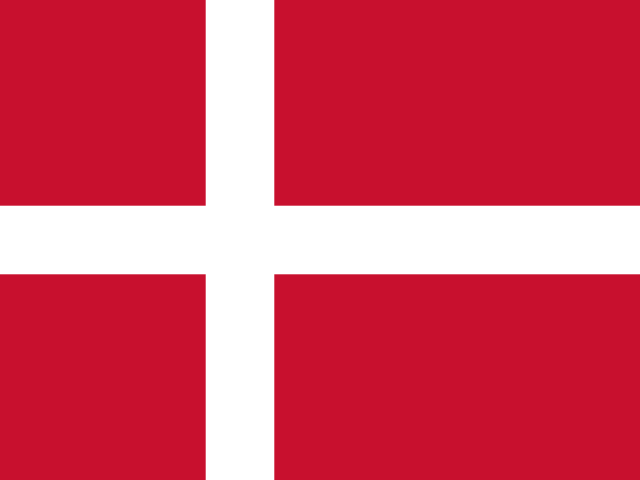
He was careful to add that Denmark’s deep Christian roots — stretching back to the baptism of King Harald Bluetooth in the 10th century and the golden age of Catholic cathedrals and monasteries that followed — must not be forgotten. “It should not be considered anti-Danish to be Catholic,” he said. “Many people think that a true Dane must be Lutheran. But we must show that you can also be a good and authentic Dane by being Catholic.”
A Church of Many Nations
Today, roughly 52,000 Catholics live in Denmark — less than one percent of the population. The Diocese of Copenhagen, the country’s only Catholic diocese, encompasses not only the Danish mainland but also Greenland and the Faroe Islands. Its 38 parishes are served by 69 priests and 10 permanent deacons.
One of its most striking characteristics is its multinational makeup. Around one third of Danish Catholics were born abroad, and on a typical Sunday in Copenhagen, Mass can be heard in Polish, English, Ukrainian, Croatian, Chaldean, French, Spanish, and Italian. Bishop Kozon himself was born in 1951 in Brovst, northern Jutland, to Polish immigrant parents who came to Denmark to work — a story that mirrors the broader character of the Church he now leads.
“It is often argued against the Danish character of the Catholic Church that it is to a large extent an immigrant Church,” he acknowledged. Yet far from seeing this as a weakness, the bishop views it as a reflection of the Church’s universal nature: one faith, expressed in the voices of many peoples.
Growth in Interest, However Modest
Bishop Kozon noted a quiet but encouraging trend: more adults are seeking out courses on the Catholic faith. “It’s about a hundred people a year,” he said, qualifying that the numbers remain modest. But he sees a more important shift beyond the statistics.
“A few decades ago, faith was something very private — even impolite to ask someone about,” he said. “Today people are more daring to talk about their faith.” That change in tone, he suggested, matters as much as any headcount.
His words come at a moment when Denmark’s broader religious landscape is itself showing unexpected movement. In August 2025, Prime Minister Mette Frederiksen — leader of the Social Democrats, a party that spent much of the 20th century reducing the Church’s public role — made a striking statement to a group of university students.
“We will need a form of rearmament that is just as important as the military one,” Frederiksen said. “That is the spiritual one.” She later told the Christian newspaper Kristeligt Dagblad that she believes people will increasingly turn to the Church because it offers “natural fellowship and national grounding,” and that “the church room has helped people through many crises.”
Three Challenges, One Mission
Bishop Kozon outlined three main challenges facing the Diocese of Copenhagen: being a Christian minority in a strongly secularized society; being a Catholic minority within a predominantly Lutheran Christian culture; and leading a Church that is deeply shaped by immigration while still seeking to be genuinely Danish.
None of these challenges, he suggested, are cause for discouragement. He is only the third Danish-born bishop since the Reformation — a reminder of how recently the Church re-established itself after three centuries of suppression. Since religious freedom was restored by the Constitution of 1849, the Church has grown steadily, if slowly.
“The Church is today an oasis of nationalities in the desert of secularization in Northern Europe,” he said — a description that captures both the difficulty of the mission and the richness of what Catholic life in Denmark has become.
The Diocese of Copenhagen can be reached at katolsk.dk. Mass times and parish information for Catholics across Denmark are available through the diocesan website.